On this page
- What the Drum Head Does: How Forestry Mulching to Clear Land Works
- Mulching vs. Bulldozing, Excavation Services and Burning in Texas
- Mulching Cedar and Mesquite: Why Texas Ranchers Choose the Drum Over the Blade
- What We Clear: Ashe Juniper, Mesquite, Huisache, Yaupon, Pine Understory, Hackberry and Bois d'Arc
- Professional Forestry Mulching Services, Including Brush Clearing and Site Prep in TX
- Clearing by Region: Hill Country Cedar, East Texas Pines, North Texas Prairie, Gulf Coast Tallow
- Mulching and Land Clearing Cost in Texas: Per Acre, Per Day, Minimum Trip
- What Size Trees Forestry Mulchers Handle Before We Fell First
- Clearing Under an EQIP Brush Management Plan, Practice 314
- What to Do After the Clearing: Seeding, Grazing, a Mow and Resprouts
- Where We Clear: Texas Land Clearing and Brush Removal from Three Yards
- FAQ
What the Drum Head Does: How Forestry Mulching to Clear Land Works
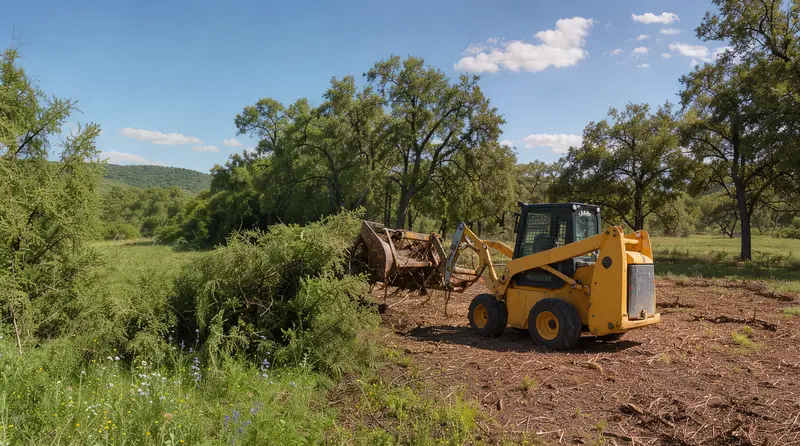
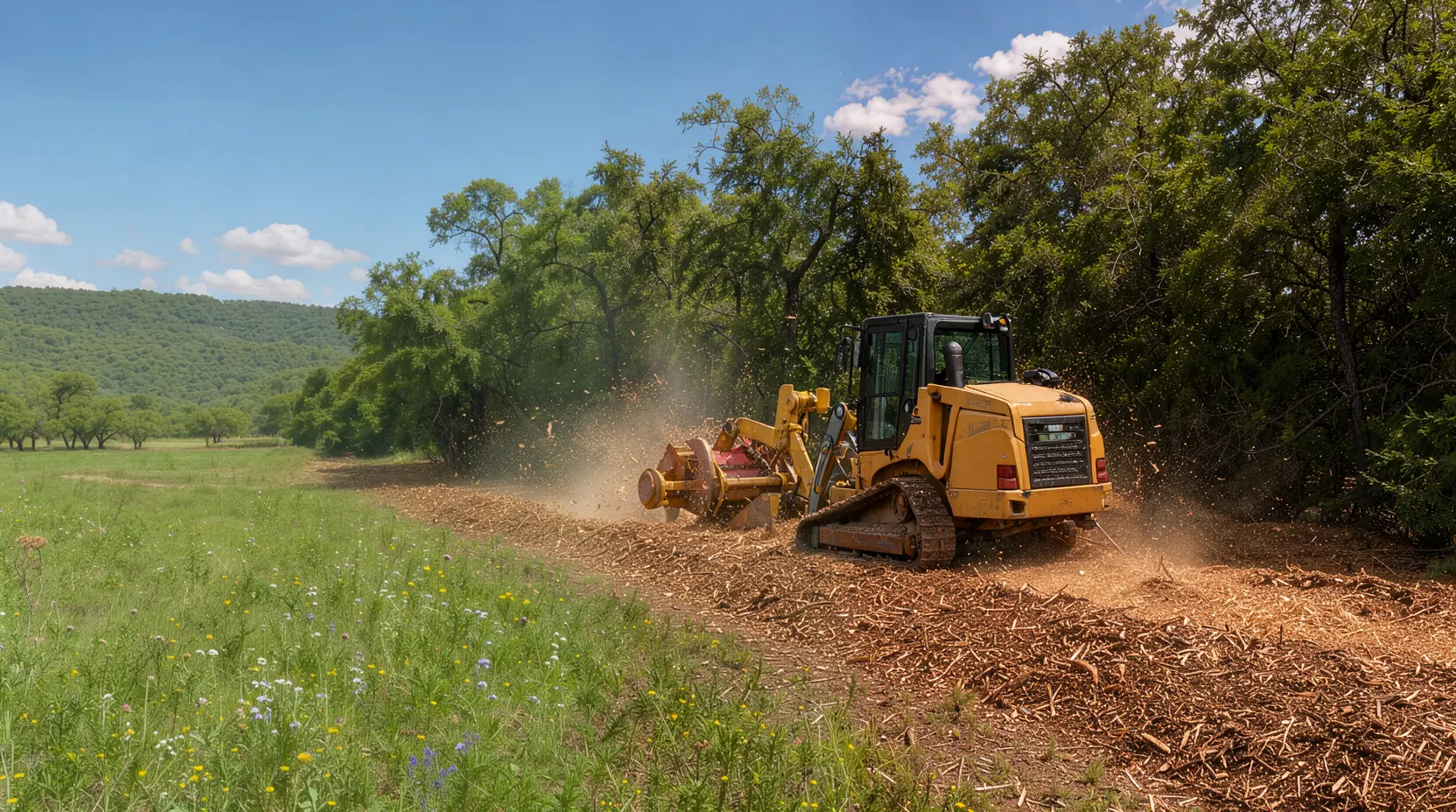
A mulching head is a steel drum with carbide teeth turning at roughly 2,000 rpm on a tracked machine. It pushes a standing cedar over and leaves a two to four inch layer of chips. The skid steer handles stems to about 8 inches. The 300-hp mulcher carries an 8 ft head and takes anything on the tract. No piles, no haul trucks, no bare dirt. Stem diameter decides which trailer leaves the yard.
Mulching vs. Bulldozing, Excavation Services and Burning in Texas
A dozer clearing job strips the top four inches of soil, and on a Hill Country slope that soil never comes back. Mulching leaves the grass and oak roots in place and lays a natural erosion barrier of chips over the dirt. Burning means you create burn piles, wait for a dry week and hope the county judge has not declared a burn ban. TCEQ rules govern every pile you light. Mulching skips that compliance problem because nothing is left to burn. On steep or wet terrain it is the only clearing method I run.
Mulching Cedar and Mesquite: Why Texas Ranchers Choose the Drum Over the Blade
A mature cedar canopy at 50 percent intercepts the first inch of a rain before it reaches the ground, and AgriLife research has measured it. Cedar here is ashe juniper. It reseeds from berries, not the stump, so one clearing pass kills it. The Blanco County tract read 55 percent canopy when I walked it. Six days, $27,500 plus transport, and the spring below the stock tank ran the next wet season. Mesquite carries buds on the root crown below grade, so a bush hog pass only invites it back. We grind the crown at the soil line. I wrote brush plans for twelve years. The brush never read one.
What We Clear: Ashe Juniper, Mesquite, Huisache, Yaupon, Pine Understory, Hackberry and Bois d'Arc
Our crews clear brush of every kind between the Red River and Corpus Christi, priced by species. Cedar and mesquite are the Hill Country and North Texas staples, huisache the southern one. Yaupon, privet and sweetgum make the East Texas undergrowth under loblolly pine. Hackberry and bois d'arc fill blackland fence lines around Dallas. Every shrub, sapling and greenbrier vine goes through the drum. Live oak, post oak, mature pine and any tree you flag with paint stay.
Professional Forestry Mulching Services, Including Brush Clearing and Site Prep in TX
Three lines leave our yards: land clearing services, including forestry mulching, brush clearing along fence lines and senderos, and site preparation for a pad or a corridor. Vegetation management along a right of way is the same machine on a narrower path. Land development on a 5 to 50 acre tract mixes all three, so a land developer gets separate lines. I do not pour concrete, drill wells, set septic or demolish houses. This is the eco-friendly end of clearing, the one an environmental sustainability review likes, because the soil never leaves.
Clearing by Region: Hill Country Cedar, East Texas Pines, North Texas Prairie, Gulf Coast Tallow
Four regions, four clearing prices. In the Hill Country the job is cedar on limestone and caliche, priced by canopy percent, and rock adds a day. Around Tyler the job is pine understory. A 15-acre Smith County tract of yaupon under loblolly took the Lindale crew 3 days at $11,400, pines kept. Out of Weatherford the crew runs mesquite and post oak pasture reclaim on blackland and Cross Timbers sand, and wet blackland adds a day from November to April. On the Gulf Coast the job is Chinese tallow on gumbo clay. The machine floats where a dozer sinks, and the Houston ring has its own site in this network.
Mulching and Land Clearing Cost in Texas: Per Acre, Per Day, Minimum Trip
Cedar clearing runs $900 to $1,400 an acre under 30 percent canopy, $1,800 to $2,600 at medium cover, and $3,000 to $4,000 for dense old-growth cedar or mesquite. The numbers come from our acres-per-day logs. Rock or caliche adds a day in the Hill Country, wet blackland adds a day up north.
- Skid steer, $2,800 a day, transport included within 60 miles of Johnson City, Lindale or Weatherford.
- 300-hp machine with the 8 ft head, $4,200 a day plus transport.
- East Texas pine understory and yaupon, $1,200 to $2,000 an acre.
- Half-acre lot, one day on the skid steer, $2,800.
- Minimum trip, $1,100. Stump grinding or full stump removal, $4 an inch, $175 minimum.
A property owner on 3-5 acres of light cedar usually lands between $2,800 and $5,600. The free on-site estimate is a standing service within 60 miles of a yard, in writing before the trailer moves. Call (832) 987-3495 or send the form and Teo will have a number to you by the end of the business day.
What Size Trees Forestry Mulchers Handle Before We Fell First
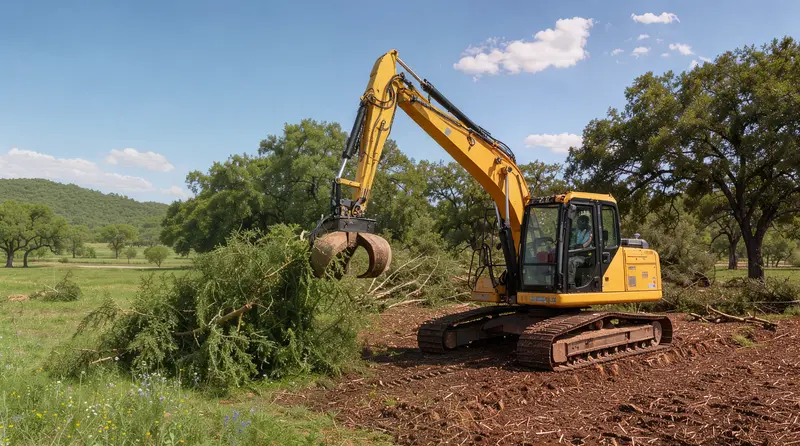
The skid steer head takes stems to about 8 inches, the 8 ft head cedar and mesquite to 12 or 14 inches. Above that the crew fells the tree with a saw and feeds the trunk through in sections. A 20-inch post oak is tree removal, not clearing, and I price it as a separate line. Mark the big ones before we arrive.
Clearing Under an EQIP Brush Management Plan, Practice 314
EQIP practice code 314 pays 50 to 75 percent of the NRCS payment-schedule rate once your plan is approved. When I wrote those plans most of them sat unexecuted because the rancher could not find a crew. Bring me your canopy map and I will tell you what the schedule pays against our clearing price. Mulching counts as mechanical treatment under 314, the same as in a forest management plan. One growing season of grazing deferment is written into nearly every plan, so budget the pasture rest.
What to Do After the Clearing: Seeding, Grazing, a Mow and Resprouts
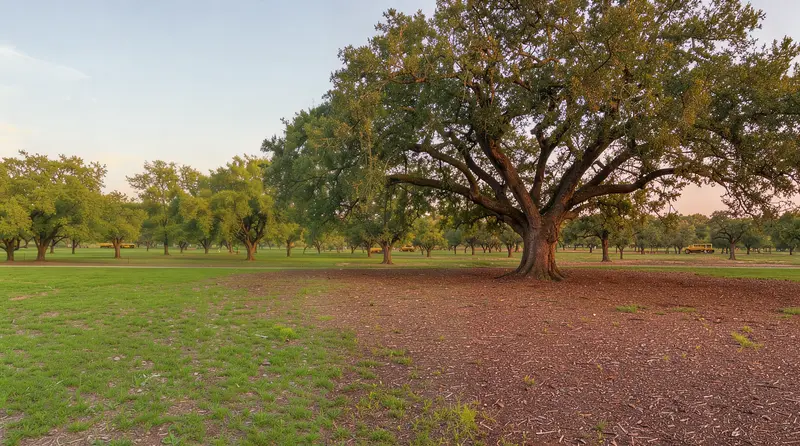
A mulch layer under three inches lets native grass come through on its own by the second spring. Over four inches, broadcast a native mix onto the chips before a fall rain. Cedar does not resprout. Mesquite, huisache and yaupon do, and a second clearing pass in year two costs a fraction of the first. Rest a reclaimed pasture one growing season, then stock at the animal units the grass carries. On our jobs in Parker County the owner runs a mow each June and the mesquite stays down. Do not let the tract overgrow again.
Where We Clear: Texas Land Clearing and Brush Removal from Three Yards
Johnson City covers the Hill Country and Central Texas, from Boerne up US 281 to Burnet and east to the 254 area code around Waco. Lindale covers East Texas: Tyler, Longview, Lufkin, Nacogdoches. Weatherford covers North Texas: Fort Worth, Denton, Collin County, Granbury. Corpus Christi gets the 300-hp unit with transport quoted. Any landowner, farm operator or business owner near a yard gets a free estimate, selective clearing included. Our clearing crews are insured, and one number reaches every crew in TX. Call (832) 987-3495 or fill out the form. Teo calls back before the end of the business day.